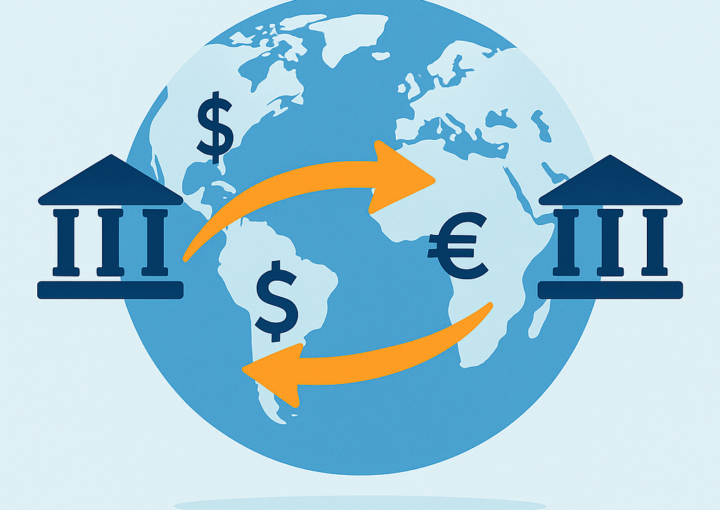
Businesses and investors regularly engage in cross-border transactions that involve foreign currencies. As exchange rates can fluctuate daily, these activities carry a significant level of financial risk. To manage this exposure, there are different tools that can be used. It’s often good to have rate alerts in place and many organisations also choose to use forward exchange contracts to reduce their exposure to hidden costs in the supply chain. In this guide, you’ll learn what a forward exchange contract is, why it’s used, and how it works in practice. We’ll also cover real-world examples and explain how margin calls can affect these agreements.
What is a Forward Exchange Contract?
A forward exchange contract is a financial agreement between two parties to exchange a specific amount of one currency for another at a predetermined exchange rate on a set future date. It is used to lock in the exchange rate in advance, protecting the parties from adverse currency movements. Learn about why exchange rates change and how to get the best rate.
Why Use a Forward Exchange Contract?
The main purpose of using a forward exchange contract is to hedge foreign exchange risk. For example, when a business expects to receive or pay a foreign currency amount at a future date, the actual cost or revenue may change depending on the market rate at that time. A forward contract provides price certainty and protects cash flow planning.
Example: Hedging USD and EUR Currency Risk
Dave is a German importer who has agreed to purchase machinery from his US supplier worth 200,000 dollars, with payment due in 90 days.
- Spot rate today: 1 euro = 1.10 US dollars
- At this rate, Dave expects to pay: 200,000 ÷ 1.10 = 181,818 euros
Dave is concerned though, because if the euro weakens over the next 90 days and the rate changes to 1 euro = 1.00 US dollar, his new cost becomes: 200,000 ÷ 1.00 = 200,000 euros
This represents a potential loss of 18,182 euros due to currency movement.
Dave decides to reduce his risk, so he calls his broker and enters into a forward exchange contract to buy 200,000 US dollars at the fixed rate of 1.10. Dave is happy with this rate and by locking in the payment at 181,818 euros, he is protected, regardless of future exchange rate changes that might occur.
Types of Forward Exchange Contracts
Fixed Forward Contract
The transaction is settled on a specific, predetermined date. This is ideal when the timing of the currency requirement is known.
Flexible Forward Contract
Settlement can occur at any time within a pre-defined range of dates, offering flexibility when the exact payment or receipt date is uncertain.
How is the Forward Rate Calculated?
The forward exchange rate is determined by the interest rate differential between the two currencies. The standard formula is:
Forward Rate = Spot Rate × (1 + Local Interest Rate) / (1 + Foreign Interest Rate)
For example:
- Spot Rate (EUR/USD) = 1.10
- Euro interest rate = 2 percent per annum
- US interest rate = 4 percent per annum
- Period = 90 days
Forward Rate = 1.10 × (1 + 0.02 × 3/12) / (1 + 0.04 × 3/12)
Forward Rate = 1.10 × 1.005 / 1.01
Forward Rate = approximately 1.095
So, the contract might be offered at a forward rate of 1.095.
What is a Margin Call?
When a business enters into a forward contract, it must place an initial margin deposit with the bank or broker. This deposit acts as collateral to cover potential losses if the market moves unfavourably. Over time, the bank actively monitors the contract’s value using a process known as mark-to-market. If the exchange rate moves against the customer’s position and the unrealised loss exceeds the margin, the bank will issue a margin call.
In response, the customer must top up the margin by depositing additional funds to maintain the contract. Failure to meet this requirement may lead the bank to close the contract. Importantly, margin calls are not only limited to contracts that are out of the money. During periods of heightened market volatility, banks or brokers may issue margin calls pre-emptively to mitigate risk. These decisions are based on internal risk analysis and current exposure levels, and they are made at the institution’s discretion under its risk management policies.
Reducing Risk through Margin Calls
Using the earlier example:
- Forward contract: Buy 200,000 US dollars at 1.10 EUR/USD
- Initial margin: 5,000 euros
After 30 days, the market rate shifts to 1 euro = 1.00 US dollar.
At 1.10: 200,000 dollars = 181,818 euros
At 1.00: 200,000 dollars = 200,000 euros
Unrealised loss: 18,182 euros
Since the loss exceeds the original margin, the bank issues a margin call. In this case, the importer will be asked for an additional amount of money to top up the deposit to maintain the contract.
Understanding the fineprint
A detailed set of terms and conditions always outline the responsibilities, rights, and risks of both parties in a Forward Contract. These terms may include settlement procedures, early termination clauses, margin policies, and legal obligations. It is essential that you fully understand and agree to these terms before signing a forward exchange contract. It’s a very good idea to ask questions at this point if you don’t fully understand the process. Failure to comply with margin calls, settlement dates, or contractual terms will often result in termination of the contract.
Benefits of Forward Exchange Contracts
- Risk management – provides protection against currency volatility
- Financial certainty – fixes future cash flow in local currency
- Flexibility – terms can be customised to match business needs
Key Considerations and Limitations
- Obligatory execution – the contract must be settled even if the market moves in your favour
- No upside – once the rate is fixed, you cannot benefit from favourable currency movements as you have committed to the contract rate.
- Margin risk – potential margin calls can affect short-term cash flow
- Legal commitment – subject to specific terms which must be strictly followed
Final Thoughts
Businesses involved in international trade and investment can benefit greatly from using forward exchange contracts. These tools help reduce exposure to foreign exchange risk and support confident financial planning. In addition, forward contracts protect against unexpected currency-related costs. However, they also come with specific obligations. For example, businesses must manage margin requirements and meet legal responsibilities as outlined in the agreement. Therefore, it is essential to fully understand how these contracts work – especially the role of margin calls and key terms – before signing one. Understanding how things work is key to getting the most out of your foreign exchange. Talk to us today to learn whether this kind of contract is suited to your business or whether you are better suited to using Spot contracts for your foreign currency requirements.